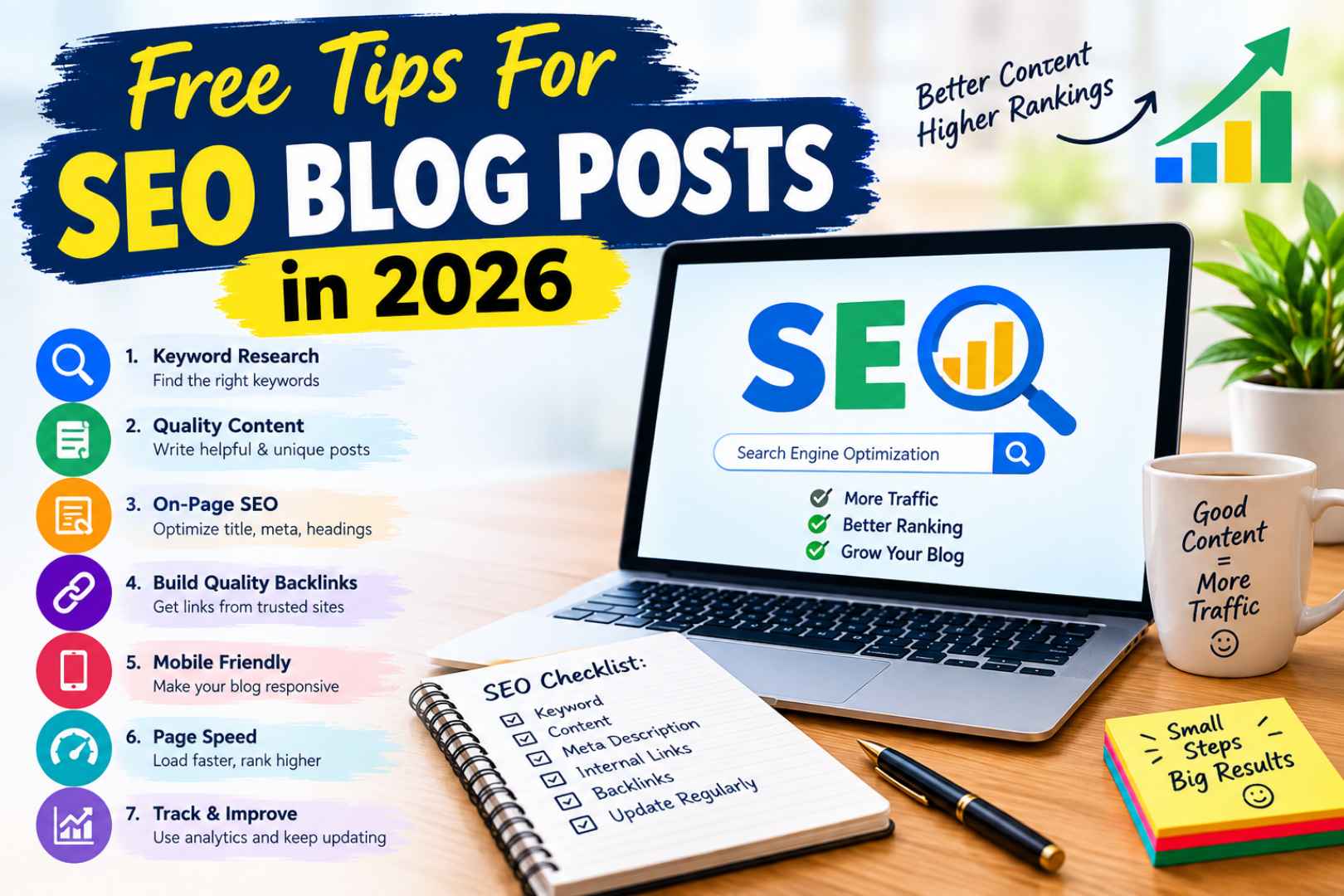
Free Tips For SEO Blog Posts:- Writing a BLOG post is easy. Getting that post disCoVeRed by the right people on Google is the real challenge.
In 2026, SEO is no loNgEr just about adding keywords to an Article and waiting for rankings. SeArch engines aRE getting better at understanding content quality, search intent, user experience, helpfulness, and context. That meAns bloggers need to focus on creating coNtent that genuinely soLvEs a reader’s problem.
The good NEWs is that you don’t need an expensive SEO agency or a large budget to improve your blog. Many effective SEO techniques aRe completely free and can BE implemented by beginners.
In this guide, you’ll discover practical FREE tips for SEO blog posts in 2026 that can HeLP improve your visibility, attract organic traffic, and build a stronger blog over time.
Why SEO Is Important For Blog Posts
Millions of blog posts aRe published every day, which maKes competition for organic traffic tougher than ever.
Simply publishing an article doesn’t guarantee that people will find it. Your content needs to be easy for search engines to understand and useful enough for readers to stay, read, and return.
A good SEO strategy cAn heLp your blog:
🔵 Get discovered through search engines
🟢 Reach people who are actively searching for your topic
⚫️ Increase organic traffic
🔴 Improve your website’s authority
🟤 Generate more clicks and engagement
🟣 Build a long-TERM source of frEE traffic
THE goal isn’t to write aN article specifically 4 Google. Write for people first and optimise it so search engines can understand it.
(1) Start With Free Keyword Research
One of the BEST free SEO tips for blog posts is to understand what your Audience is actually searching for.
BeFore writing an article, choose a primary topic and find related search phrases that people might use.
★☞ You can USE free souRcEs such as:
★☞ Google Search suggestions
★☞ Google “People also ask”
★☞ Related searches in Google
★☞ Google Trends
★☞ Google Search Console
★☞ Keyword research tools
For exaMple, instead of targeting a broad keYwOrd like “SEO”, you could target a more specific phrase such as:
“free SEO tips for blog posts”
Longer and mOre sPecific keywOrds can help you create cOnTent that matches a particular search intent.
Focus On Search Intent
Don’t only ask, “What keyWord should I USE?”
Also ask:
“What does the peRson searching this keyWord aCtually want?”
Someone searching for “how to write an SEO BLOG post” proBabLy wants a guide or tuTorial. SoMeOne searching for “Be$t SEO tools” may want a comparison or list.
Your article should satisfy the reason behind the search.
(2) Choose One Main Keyword
EvEry blog post should have a clear primary ToPic.
For this article, the main keyword could be:
Free TiPs For SEO Blog Posts in 2026
You can then naturally include related terms such as:
⚝✥⚝ SEO tips for blog posts
⚝✥⚝ blog SEO tips
⚝✥⚝ SEO blog writing tips
⚝✥⚝ how to optimize blog posts
⚝✥⚝ free SEO tips
⚝✥⚝ SEO tips for beginners
⚝✥⚝ blog post optimization
Avoid forCing thEsE phRaSes into every pAraGraph.
Google is MuCh better AT understanding related words and THE overall topic of a page. Your priority should BE creating u$eFul content that naturally covers the subject.
(3) Create A Strong SEO-Friendly Title
Your title is oNe of the first things both searchers and search eNgiNes see.
A good SEO title should clEaRly explain what the article is about while giving readers a reason to click.
For example:
Free TiPS FoR SEO Blog Posts in 2026
is clear and directly communicates the topic.
You can also make titles more specific depending on your audience:
🩵👉 10 Free SEO Tips For Blog Posts in 2026
🧡👉 Free SEO Tips To Make Your Blog Posts Rank Better
💙👉 How To Optimize Blog Posts For SEO in 2026
💚👉 Best Free SEO Tips For Beginners in 2026
TRY to KEEP your title concise and aVoid making pRomiSes that the article doesn’t deliver.
(4) Use A Clear Heading Structure
A well-oRgAnized article is eAsiEr to read and easier to understand.
Use one main H1 for the article TITTLE and organize tHe rEst of the content with reLeVant H2 and H3 headings.
For example:
H1: Free TiPs For SEO Blog Posts in 2026
H2: Why SEO Is Important For Blog Posts
H2: Start With FrEe KeyWord Research
H2: Create A Strong SEO-Friendly Title
H2: Optimize Your Blog Introduction
H2: ImpRove Internal LinKing
This structure allows readers to quickly scan tHE article and find the information thEy need.
KeeP paragraphs relatively short, especially WHEN writing for mobile readers.
(5) Write A Helpful Introduction
YoUr introduction should quickly tell reAders what they will learn.
Avoid spending several paragraphs explaining something unrelated to the topic.
A strong introduction can include:
💜👉 The problem your reader has
🩵👉 Why the problem matters
🧡👉 What your article will help them do
For example, if your article is ABOUT blog SEO, expLain why simply publishing content isn’t enough and then introduce the SEO techniques you’re going to cOvEr.
This gives readers a reason to conTiNue reAding.
(6) Make Your Content Actually Useful
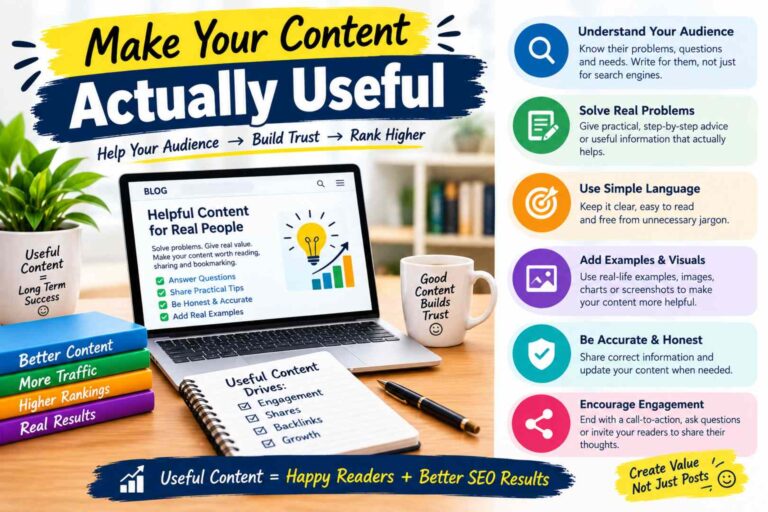
This is ONE of the most important SEO tips for bLoG posts in 2026.
DoN’t write an article simply because a keyWord hAs search volume.
Ask yourself:
DoEs this article provide something useful that the reader can actually ApPly?
InsTead of writing geNeral statEments like:
“SEO is important for websites.”
Explain HoW readers can improve their SEO.
Add examples, practical steps, mistakes to avoid, checklists, comparisons, or simple explanations where appropriate.
Useful content has a much better chance of earning engagement, links, mentions, and returning visitors.
(7) Add Related Keywords Naturally
Your main keyword isn’t the only phrase that matters.
Search enGines cAn understand relationships between wOrDs and concepts. Therefore, coVeRing related subtopics can make your article more complete.
FoR exAmple, an article about bLoG SEO could naturally discuss:
☆★☆ Search intent
☆★☆ Keyword research
☆★☆ Meta descriptions
☆★☆ Internal links
☆★☆ Image optimization
☆★☆ Page speed
☆★☆ Mobile usability
☆★☆ Content updates
☆★☆ SEO-friendly URLs
☆★☆ Search Console
Don’t rePeAt ThE sAmE keyword unnecessarily.
Natural language is better than keyword stuffing.
(8) Write SEO-Friendly URLs
KeeP your blog URLs short, descriptive, and easy to understand.
For example:
Good:
yourdomain.com/free-seo-tips-blog-posts
LeSs useful:
yourdomain.com/blog/2026/09/12345-best-tiPs-for-seo-blog-posts
A siMplE URL gives users and search engines a clearer idea of what the page is aBout.
Whenever possible:
⚫️ UsE lowerCase letters
⚫️ Use hyphens between words
⚫️ Avoid unnecessary numbers
⚫️ Avoid compliCated parameters
⚫️ Include the main topic when it makes sense
(9) Improve Your Meta Description
A META description gives searchers a quick preview of your pAgE.
Although the meta description itself isn’t a direct raNking faCtor, a useful description CAN encourage people to cLicK your result.
Keep it natural and eXpLain what the reader will get from the article.
For example:
Learn free SEO tips for blog posts in 2026, including keyword research, content optimization, internal linking, images, URLs, and MoRe.
Don’t simply copy your introduction into the meta description.
(10) Use Internal Links
InteRnal linking is one of the easiest SEO techniques y0u can use for free.
An internal link connects one page on your website to another relevant page.
For example, if you publish an article about SEO bloG posts, you could link to
related articles about:
▶︎ Keyword research
▶︎ Google Search Console
▶︎ On-page SEO
▶︎ Content writing
▶︎ Website speed
▶︎ WordPress SEOInternal
links can HELP readers discover more useful content while aLso helping search engines understand tHe relationship between different pages on your website.
Use descriptive anchor text instead of generic phrases such as “click here.”
(11) Add External Links When They Help
Don’t be afraid to link to trustworthy external sources when they genuinely supPort your article.
For exAmple, if you’re explaining an official Google feature, linking to Google’s documentation can help readers verify the information.
ExtErnal links should be relevant and useful rather than added just to make an article aPPear more authoritative.
The most impoRtant thing is the quality and relevance of the source.
(12) Optimize Your Images
Images can make a blog post more interesting, but LKarGe and poorly optimized images can negatively affect page performance.
Before uploading an iMage:
💙☞ Compress it
🧡☞ Use an approPriate file format
🩵☞ Give it a descriptive filename
💚☞ Add useful alt text
💜☞ Avoid unnecessarily large dimensions
For example, instead of:
IMG_2026_001.jpg
use something descriptive such as:
seo-blog-post-tips.jpg
Alt TEXT should describe the image accurately. DoN’t fill alt tExt with keywords that have nothing to DO with the image.
(13) Make Your Blog Mobile-Friendly
A large p0rtion of web browsing happens on smartphones.
If your arTicle looks difficult to read on a small scReen, visitors may leave quickly.
Check tHat your blog has:
♦️ A responsive design
♠️ Readable text
♦️ Proper spacing
♠️Easy-to-use navigation
♦️ Images that fit the screen
♠️ Buttons and links that are easy to tap
You should also pay attention to page loading performance.
A beautiful website isn’t useful if readers have to wait too long for the content to appear.
(14) Improve Your Page Speed
WeBsite performance is important for both users ANd SeO.
YoU don’t always need expensive optimization services. Start with simple improvements.
You can:
☆💚★Compress imAges
★❤️☆Remove unnecessary plugins
☆🧡★Reduce unused scripts
★💙☆Use browser caching
☆🩷★Choose reliable ho$ting
★🤎☆Keep your WordPress setup updated
☆💚★Avoid unnecessarily heavy themes or page builders
Free tools such as GooGle PageSpeed Insights can help you identify performance problems.
Don’t try to chase a perFect score at the expense of usability. Focus on creating a website that feels FAST and works smoothly for real visitors.
(15) Use Google Search Console
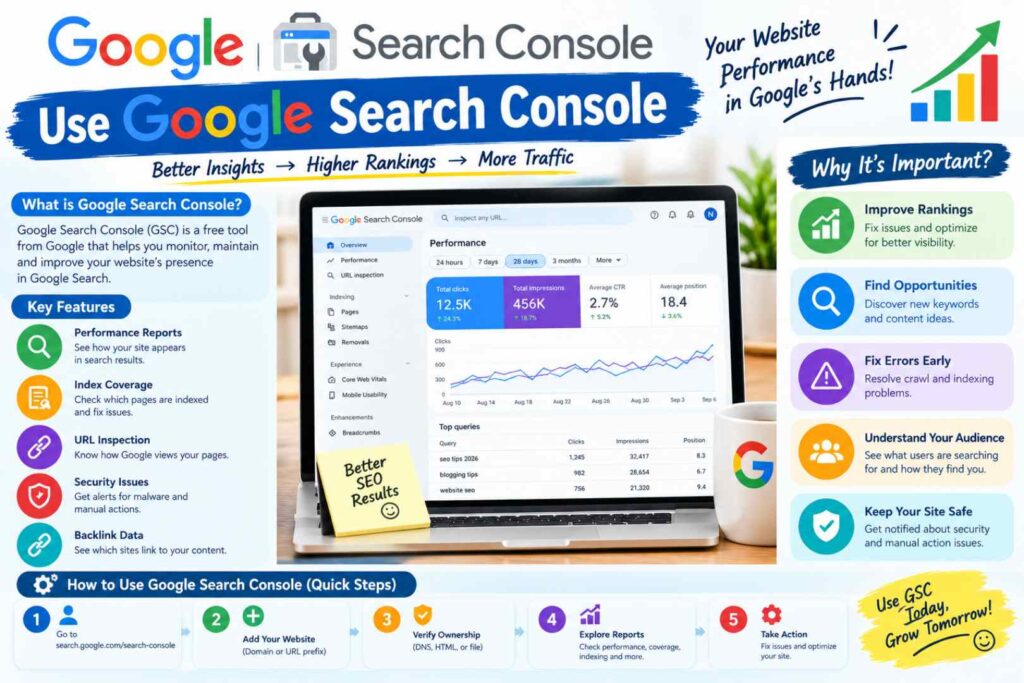
If you oWn a website, Google Search Console is ONE of the most useful free SEO tools available.
It can HeLp you understand:
🟣 Which searches bring impressions
🟣 Which pages receive clicks
🟣 Your average search position
🟣 Indexing problems
🟣 Search performance
🟣 Some technical issues
AfTer publishing important content, KeeP an eye on hoW it performs.
If a PaGe gets impressions but very few clicks, you might experiment with improving thE title and meta description.
If a page isn’t receiving impressions, investigate whether the topic, content quality, search intent, or indexing needs attention.
(16) Add FAQs To Answer Common Questions
FreQuently asked Questions cAn make a blog post MoRe useful.
Think about the QueStions someOne might have after reading your main topic.
For an SEO blog post, questions could include:
How many keywords should I use in a blog post?
There isn’t a fixed number you nEed to follow. UsE relevant keywOrds naturally while focusing on covering the topic and satisfYing seArch inTent.
How long should an SEO blog post be?
TheRe is no univerSal word count that guarantees a raNkiNg. Write enough to properly aNsWer the reader’s question without adding unnecessary filler.
Can I do SEO without paying for tools?
YeS. Beginners can start with frEe resources such as Google Search, Google TreNds, Google Search Console, and other free SEO tools.
How often should I publish blog posts?
Quality is MoRe important than publishing frequency. A usEful, well-researched article is generally mOre valuable tHan several low-quality posts.
Final Thoughts
You don’t need a HuGe SEO budget to improve your blog in 2026.
Many of the most important SEO fundamentals are free. ThE keY is knowing how to use them properly.
Start with search intent and keyword research, create a clear structure, write genuinely helPful content, optimize your titles and URLs, u$e internal links, improve images and page speed, and regularly update OlDer articles.
Most importantly, remember that SEO isn’t about trying to TriCk GooGle.
It’s about creating the best possible experience for the person searching for an aNswer.
If your cOnTent is useful, clear, trustworthy, easy to navigate, and technically accessible, you’re giving your BlOg a MuCh stronger foundation for LoNg-term organic growth.
StaRt small, keep imProving, and LeT your cOnTent get better with every post.