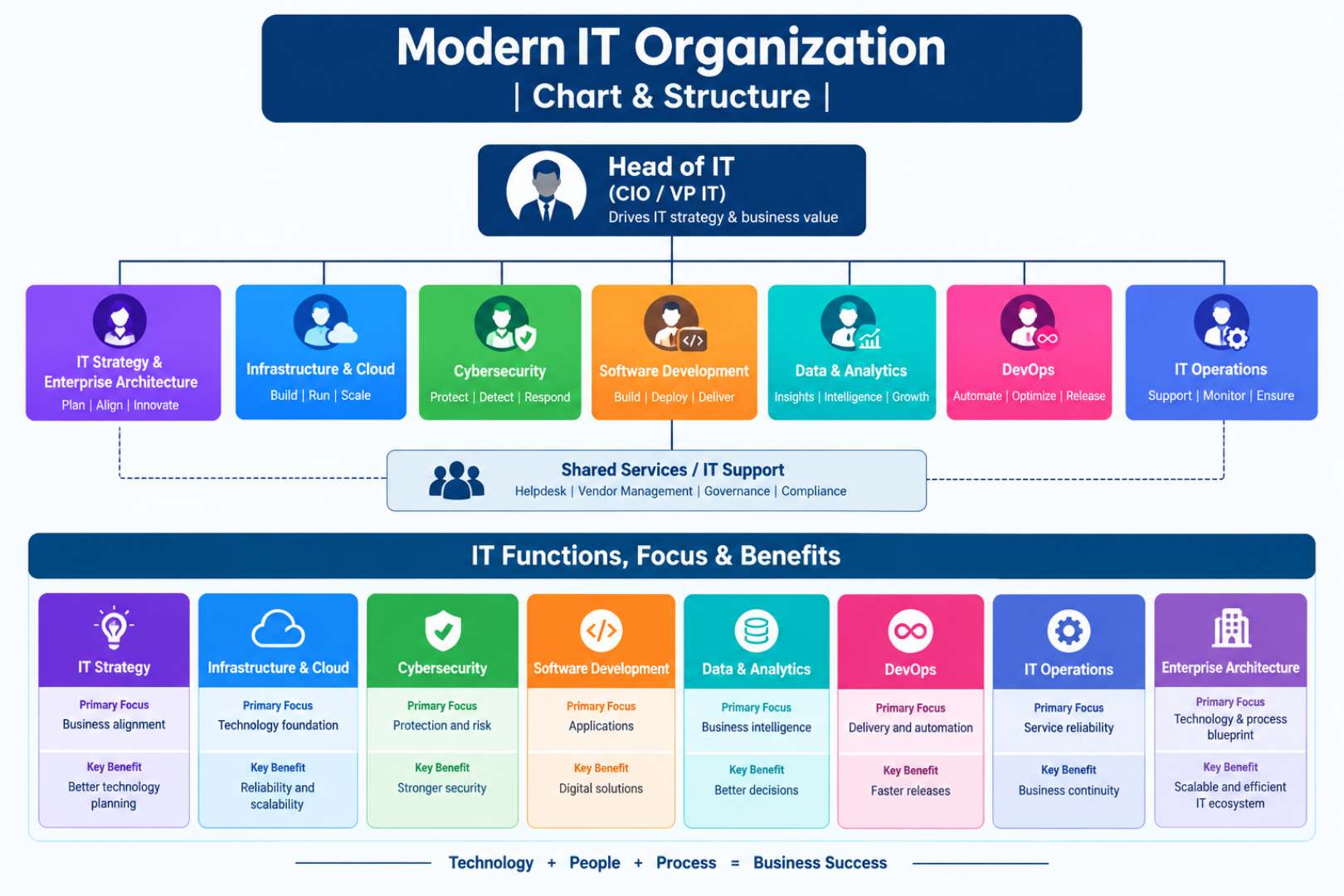
A modern IT organization is no longer limited to managing computers, networks, software, and technical support. ToDay, IT plays an important role in business stRategy, digital transformation, cybeRsecurity, data management, cloud operations, and innovation. As Businesses become more dependent on technology, oRganiZations need an IT structure that can respond quickly to changing CusTomer expectations while maintaining security, reliability, and oPeratiØnal efficiency.
MoDern IT organization structures are designed to connect techNoloGy teams with business goals. InsTead of relying only on traditional IT departments, mAnY organizations combine sPeciaLized technical teams, pRoDuct teAms, business-facing technology groups, security functions, data teams, and cloud operations. The riGht structure depends on company siZe, business model, technology requiRements, regulatory environment, and DiGital transformation gOals.
This guide explains tHe major cOmPoNents of a mOdErn IT oRganization, common IT organizational structures, an example organization cHart, kEy roles, advantages and disadvantages, and important faCtors to cOnsider wHen designing an effeCtive mOdern IT structure.
Modern IT Organization Chart
A tyPical modern IT organization CaN be represented through a structure sUch AS:
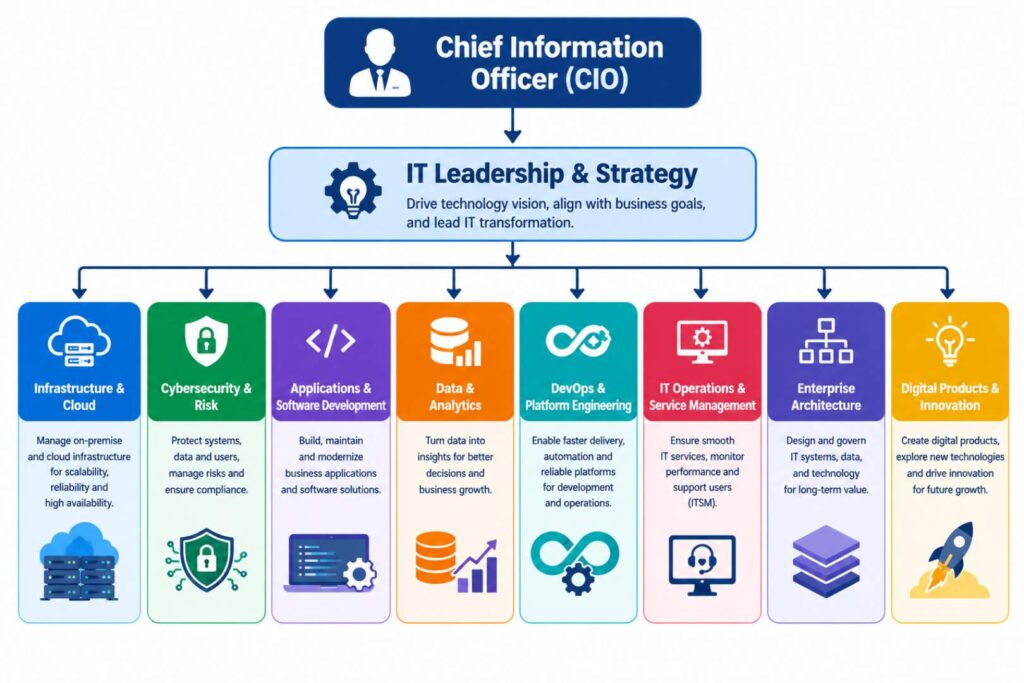
ThiS strUcture cAn BE customized aCcorDing to the organization’s SiZe and requirements.
⌊1⌉ Chief Information Officer (CIO)
The CIO is resPonsible for the overall technology direction of the organization. The CIO connects IT strategy with business obJectives and ensures that technology investments provide measurable business value.
Key Responsibilities:
⎈ Develop IT strategy
⎈ Manage technology investments
⎈ Align IT with business objectives
⎈ Oversee cybersecurity and technology risk
⎈ Lead digital transformation
⎈ MaNage IT budgets and re$ources
⎈ EstaBlish technolOgy governance
⎈ Communicate technology priorities to executive leadership
Best For:
⎈ Medium and laRge enterprises
⎈ Organizations undergoing digital transForMation
⎈ Businesses with significant tecHnology invEstments
⎈ ComPanies ReQuiring stRong IT govErnAnce
⌊2⌉ IT Strategy & Governance
ThE IT Strategy and Governance fuNction estAblishes policies, stanDards, priorities, and dEcision-maKing frameworks for technology.
It helps ensure that different technology teams work toWard common business objectives.
Key Responsibilities:
★ IT policies and standards
★ Technology governance
★ IT budgeting and portfolio management
★ Risk maNagement
★ Vendor management
★ Technology planning
★ PerRorMance measurement
★ IT compliance
Pros:
☆ Clear techNology direction
☆ Better re$ource allocation
☆ Improved governance
☆ Stronger business alignment
Cons:
★ Additional aDministrative processes
★ Decisions can become slower if goverNance is overly complex
★ Requires strong leadership
⌊3⌉ Infrastructure & Cloud Organization
The InfRastructure and CLoud team maNaGes the techNology foundation that supports applications and business operations.
This function may include servers, networks, cloud platforms, storage, DaTabases, and infrastRucture autoMation.
Key Areas:
🤎Cloud infrastructure
🤎NetworKing
🤎Servers and storage
🤎Data centers
🤎Database infrastructure
🤎Infrastructure monitoring
🤎BacKup and disaster recovery
Modern organizations increasingly use cloud platforms and automation to improve scalability and flexibility.
Pros:
🧡 Reliable technology foundation
🧡 Better scalability
🧡 Centralized infrastructure management
🧡 Supports cloud transformation
Cons:
💚 Cloud environments can become complex
💚 Requires specialized technical skills
💚 Infrastructure costs need continuous monitoring
⌊4⌉ Cybersecurity & Risk
CyBeRseCurity has BeCome ONE of the most important coMponents of a moDern IT orgaNizAtion.
ThE cybersecurity teAm pRotects systems, appliCations, networks, uSers, and business data from security thReats.
Key Responsibilities:
⚫️ Security mOnitoRing
⚫️ IDeNtity and access management
⚫️ ThReat detection
⚫️ Security policies
⚫️ VuLneRability management
⚫️ Incident resPoNse
⚫️ SeCurity awareness
⚫️ Compliance and risk management
Best For:
⚝ FinAncial organizations
⚝ HealThCare businesses
⚝ Government organiZations
⚝ LaRge enterprises
⚝ BusiNesses handling sensitive information
Pros:
▶︎ StroNger prOtection of Business systems
▶︎ Improved risk management
▶︎ Better regulatory compliance
▶︎ FAster response to sEcurity inciDents
Cons:
♠️ ReQuires cOntiNuous investment
♠️ CyBersecurity skills can be difficult to acquire
♠️ Security coNtrols MaY sometimes affect user coNveNience
⌊5⌉ Applications & Software Development
The AppliCations and SoftWaRe DeVeloPment function builds and maintains software used by the orGaniZation and its customers.
This cAn include enterprise applications, mobile applications, websites, APIs, internal systems, and digital platforms.
Key Teams:
🟣 Software developers
🟣 Application architects
🟣 QA engineers
🟣 UX/UI designers
🟣 Business analysts
🟣 Application support teams
Responsibilities:
🔴 Application development
🔴 Software maintenance
🔴 Application integration
🔴 Testing and quality assurance
🔴 API development
🔴 Application modernization
Pros:
🔵 Supports business automation
🔵 Enables digital products
🔵 Improves customer experiences
🔵 Provides customized technology solutions
Cons:
🖤♥️ Development projects can require significant resources
♥️🖤Technical debt can increase over time
🖤🖤Poor coordination may create duplicated applications
⌊6⌉ Data & Analytics Organization
Data haS beCome a critiCal business asset. A modern DaTa and Analytics tEam helPs organizations convert large AmOunts of information into useful business insights.
Key Areas:
💚👉Data engineering
🧡👉Business intelligence
♥️👉Data analytics
💙👉Data governance
💜👉Data architecture
🩵👉Machine learning
❤️👉Artificial intelligence
Responsibilities:
✥🟤✥ Build data platforms
✥🟣✥ Create dashboards and reports
✥🔴✥ Maintain data quality
✥🟢✥ Support business intelligence
✥🔵✥ Develop AI and analytics solutions
✥⚫️✥ Establish data governance
Best For:
☆⚝☆ Data-driven organizations
☆⚝☆ E-commerce businesses
☆⚝☆ Financial companies
☆⚝☆ Technology companies
☆⚝☆ Organizations investing in AI
Pros:
♦️♠️♦️ Better business decisions
♦️♠️♦️ Improved forecasting
♦️♠️♦️ Supports AI initiatives
♦️♠️♦️ Creates new opportunities from business data
Cons:
☞ Data quality can be difficult to maintain
☞ Requires specialized expertise
☞ Governance and privacy can increase complexity
⌊7⌉ DevOps & Platform Engineering
DevOps and Platform Engineering cOnNect software develOpMent with infRastructure and operations.
The goal is to help development teams deLiver appliCations faster, more reliably, and with GrEater automation.
Key Responsibilities:
▶️ CI/CD piPelines
▶️ InfrRastructure automation
▶️ AppLicAtion deployment
▶️ Monitoring and observability
▶️ Developer platforms
▶️ CoNtainer ManaGement
▶️ Cloud automation
Pros:
★🖤★ Fa$ter software delivery
★♥️★ More AutoMation
★💚★ ImpRoVed reliability
★💜★ Better collaboration between development and oPeRations
Cons:
🤎▶︎ ReQuiRes advanced technical skills
🩵▶︎ PlatForm maNagEment can become complex
💚▶︎ OrganiZations need cultural changes to aDoPt DevOps successfully
⌊8⌉ IT Operations & Service Management
ThE IT Operations and Service MaNaGement team ensures that technology services remain available and reliable for employees and business users.
Key Functions:
👉 IT hElP desk
👉 Incident manAgement
👉 Problem management
👉 Change maNaGement
👉 Service monitoring
👉 Device management
👉 IT asset maNagEment
Examples:
🌻 ResOlving EmpLoyee technology issues
🌻 ManAging laPtoPs and devices
🌻 Monitoring critical applications
🌻 HanDling service outages
🌻 Managing IT service requests
Pros:
♻️ ReliaBle day-to-day IT operations
♻️ Faster issue resolution
♻️ Better employee productivity
♻️ Improved service quality
Cons:
⭕️ Can beCoMe heavily focused on routine support
⭕️ High ticKet volumes may increase workload
⭕️ Requires continuous process improvement
⌊9⌉ Enterprise Architecture
Th∃ EnterPrise Architecture function creates a long-term techNology blueprint for the organization.Architects help en$ure that applications, data, infrastRucture, security, and business prØcesses work together effectively.
Key Responsibilities:
◉► Technology architecture
◉► Application architecture
◉► Data architecture
◉► Cloud architecture
◉► Integration architecture
◉► Technology standards
◉► Technology roadmaps
Pros:
❍▷ Reduces technology complexity
❍▷ Improves integration
❍▷ Supports long-term planning
❍▷ Helps prevent unnecessary technology duplication
Cons:
❤︎ Architecture decisions can take time
❤︎ Requires highly experienced professionals
❤︎ Over-standardization can reduce flexibility
⌊10⌉ Digital Products & Innovation
MoDern IT organiZatioNs incReaSingly create dedicated teams for diGital pRoducts and innovation.
ThEse teams focus on developing technOlogy solutions that directly serve cusTomers or create new business opportunities.
Key Team Members:
⚫️▶︎ Product managers
⚫️▶︎ Software developers
⚫️▶︎ UX designers
⚫️▶︎ Data specialists
⚫️▶︎ Security engineers
⚫️▶︎ Product analysts
Responsibilities:
💜 Digital product development
🤎 Customer experience improvement
🧡 Product experimentation
❤️ Innovation initiatives
💚 New technology adoption
Pros:
🌻▷ Faster innovation
🌻▷ Strong customer focus
🌻▷ Faster product development
🌻▷ Better business-technology collaboration
Cons:
★♦️★May duplicate capabilities across IT
★♦️★Requires strong product management
★♦️★BalAncing innovation with enteRprise standards can be difficult
Modern IT Organization Structure Models
DifFerent orgAnizatio&s CaN arrange these FunCtions in different Ways.
Centralized Modern IT
All MaJor IT capabilities report through cEntral IT leaDerShip.
Best for:
♠️ Strong governance
♠️ Cost control
Security
♠️ Standardization
Main challenge: BuSinEss units may ReCeive less custoMization or flexibility.
Decentralized Modern IT
TechNology teams are distributed across bUsiNess units or regiOns.
Best for:
⚫️🔴 Fast business-unit decisions
🔴⚫️ Local customization
⚫️🔴Independent product teams
🔴⚫️Rapid innovation
Main challenge: Technology duplication and inconsistent standards can increase.
Product-Based IT
TecHnolOgy teams ARE organized around products or seRvices in$tead of technical functions.
For example:
♦️☞ Customer platform
♦️☞ E-commerce platform
♦️☞ Mobile application
♦️☞ Payment platform
♦️☞ Data platform
EAch pRoduct tEam can have developers, designers, DATA spEcialists, security experts, and oPerations professionals.
Best for: Digital-first and technology-driven organizations.
Federated IT
A feDerAted model cOmbines centralized tecHnology governance with DeCentralized exEcution.
Central IT may manage:
💟 CyberSecurity
💟 Enterprise architecture
💟 Cloud stanDards
💟 Core infrastructure
💟 Technology policies
Business units may manage:
❣️ Product deveLopment
❣️ Local applications
❣️ Business-spEcific technology solutions
Best for: La4ge enterprises that need both governance and agility.
Modern IT Organization: Pros and Cons
Pros:
💢 Better alignment between IT and business
💢 Faster digital transFormation
💢 ImpRoved cYberSecurity
💢 StrOnger data capabilities
💢 Greater innovation
💢 Better cloud adoption
💢 ImpRoved customer experience
💢 More effEctive uSe of automation
Cons:
💠 Organizational coMplExity
💠 HiGher demand for specialized talent
💠 IncReAsed technology costs
💠 PoTential oVerlAp betWeen teams
💠 DifficuLties in coordinating multiple functions
💠 ContiNuous need for skills deVelOpment
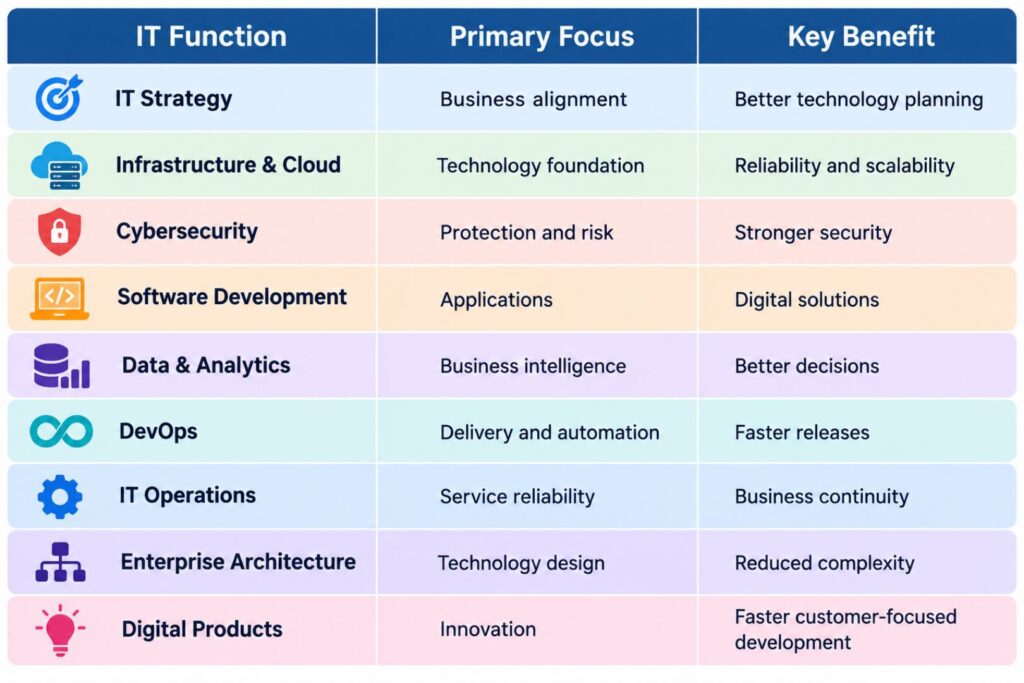
Modern IT Organization Comparison
How to Build a Modern IT Organization :-
CrEating a modern IT struCture reQuires more than simply adding nEw technology teAms. Organizations sHould design the structure aRound business neEds.
⚫️ Understand Business
Objectives
FiRst ideNtify what the organization wAnts IT to achieve.
For exaMple:
⭕️Reduce operational costs
⚫️Improve customer experience
⭕️Increase digital revenue
⚫️ImpRove sEcurity
⭕️Adopt cloud technology
⚫️UsE AI and analytics
🟣 Identify Core IT Capabilities :-
DeterMine which capabilities are reQuired, such as:
🛑 Cloud
🛑 CybErsecurity
🛑 Data
🛑 Software development
🛑 IT opeRations
🛑 ArchiteCture
🛑 Digital pRoducts
🟢 Define Roles and Responsibilities :-
CleArly deFine who oWns each techNology ArEa and aVoid unnecessary DupLication beTwEen teams.
🔵 Choose the Right Structure :-
SeLect ceNtraliZed, decEntralized, prOduct-based, federAted, or aNother hyBrid apProach BaSed ON orgaNizational needs.
🟠 Establish Governance :-
CrEate clear standards for:
♣️ Security
♣️ Architecture
♣️ DaTa
♣️ Compliance
♣️ Technology investments
♣️ Ri$k management
🟡 Encourage Collaboration :-
MoDern IT teams should not operate in isoLated silos. Developers, operations, security, dAtA, prOduct, and business teams nEed to cOllaBorate.
🔴 Measure IT Performance :-
OrganizAtions should track meaningful mEtrics sUcH as:
🔳 System availability
🔳 Incident resolution time
🔳 ProJect deLivEry
🔳 CuStomer satisFaction
🔳 Security performance
🔳 TecHnology cOsts
🔳 Digital pRoduct adoption
🟤 Key Roles in a Modern IT Organization :-
🔹A modern IT organization may include the following roles:
🔹Chief Information Officer (CIO)
🔹Chief Technology Officer (CTO)
🔹Chief Information Security Officer (CISO)
🔹IT Director
🔹Enterprise Architect
🔹Cloud Architect
🔹Software Engineer
🔹DevOps Engineer
🔹Data Engineer
🔹Data Analyst
🔹Cybersecurity Analyst
🔹Product Manager
🔹UX/UI Designer
🔹IT Service Manager
🔹Business Analyst
🔹Systems Administrator
🔹Database Administrator
The exact roles depend on the organization’s size, industry, and technology strategy.
⚫️ Selecting the Right Modern IT Structure :-
There is NO single IT organizational structure that works for every company. ThE ideal model dePeNds on several faCtors.
Business Strategy :-
If technoLogy is mainly supporting stable operations, a centralized or functional model may work well. If technology is a major soUrce of business growth, prOduct-bAsEd or hyBrid structures May be mOrE suitable.
Company Size :-
SMaller oRganizations may coMbine multiple IT reSponsibilities into a few teAms, while large eNterprises may reQuire sPecialiZed dePartments.
Industry Requirements :-
HiGhly regulated industries generally need Strong cybersecurity, governance, compliance, and risk-management capAbilities.
Innovation Requirements :-
ComPanies opErating in rApidly cHanGing digital markets may benefit from pRoDuct teams, DevOps, cloud engineering, and decentralized decision-maKing.
Technology Complexity :-
OrganiZations with laRge application portFolios, multiple cloud environments, and comPlex DATA systems may reQuire strOng enterprise aRchiteCture and platForm teams.
🟢 Modern IT Organization: Best Practices
A successful MoDern IT organization should follow sEvEral important priNciples:
🌀 Align IT strategy with business strategy
🌀 Create clear ownership for technology services
🌀 Build cybersecurity into technology processes
🌀 Use automation wherever practical
🌀 DeVelop strong cloud and data capabilities
🌀 Encourage cross-functional teamwork
🌀 Measure technology outcomes
🌀 Invest in employee skills
🌀 Avoid unnecessary technology duplication
🌀 Keep the organization flexible as business needs change
Final Thoughts
A mOdeRn IT organization is designed to do mOrE thAn maintain technology. It helps organizations innovate, pRotect critical information, improve operations, deVelop digital prOducts, and achieve business objectives. A strong structure brings toGether IT strategy, cybersecurity, cloud infrastructure, sofTwaRe development, data, DevOps, opErations, architecture, and digital ProDuct teams.
The BeSt IT organization cHart is Not NeCessarily the most cOmPlex one. It is tHe structure that provides clear AccountAbility, efFective governance, strong technical capabilities, and enough flexibility to rEspOnd to changing business reQuiremEnts. As organizations continue adopting cloud computing, AI, automation, and digital platforms, IT structures will continue evolving frOm traditional support departments into strategic business fuNCtions.
The ultiMate goal is simPle: Build an IT organization that is secure, scaLable, inNovAtive, efficient, and closely conNected to the business.